Table of Contents
Introduction
A 4k iptv encoder is the hardware that makes ultra-high-definition internet television distribution possible. As 4K UHD displays have become mainstream across homes, hotels, conference rooms, and public venues, the demand for encoding hardware capable of capturing, compressing, and streaming 3840×2160 video over network infrastructure has grown substantially. In 2026, the 4k iptv encoder has moved from a specialist professional purchase to an accessible solution for a much broader range of deployment scenarios.
Whether you’re upgrading an existing IPTV system to support 4K content, building a new hotel headend with ultra-HD capabilities, streaming live events in 4K for a premium audience, or distributing 4K corporate video across a campus network — the choice of 4k iptv encoder determines the quality ceiling of your entire distribution chain.
This guide covers how a 4k iptv-encoder works, the specifications that matter most at this resolution, why H.265 is the dominant codec at 4K, the network requirements involved, key use cases, how to set one up, and answers to the questions buyers most commonly ask before investing in ultra-HD encoding hardware.
How a 4K IPTV Encoder Works
The core function of a 4k iptv encoder follows the same principles as any video encoding device — but the demands at ultra-high definition are significantly greater at every stage of the process.
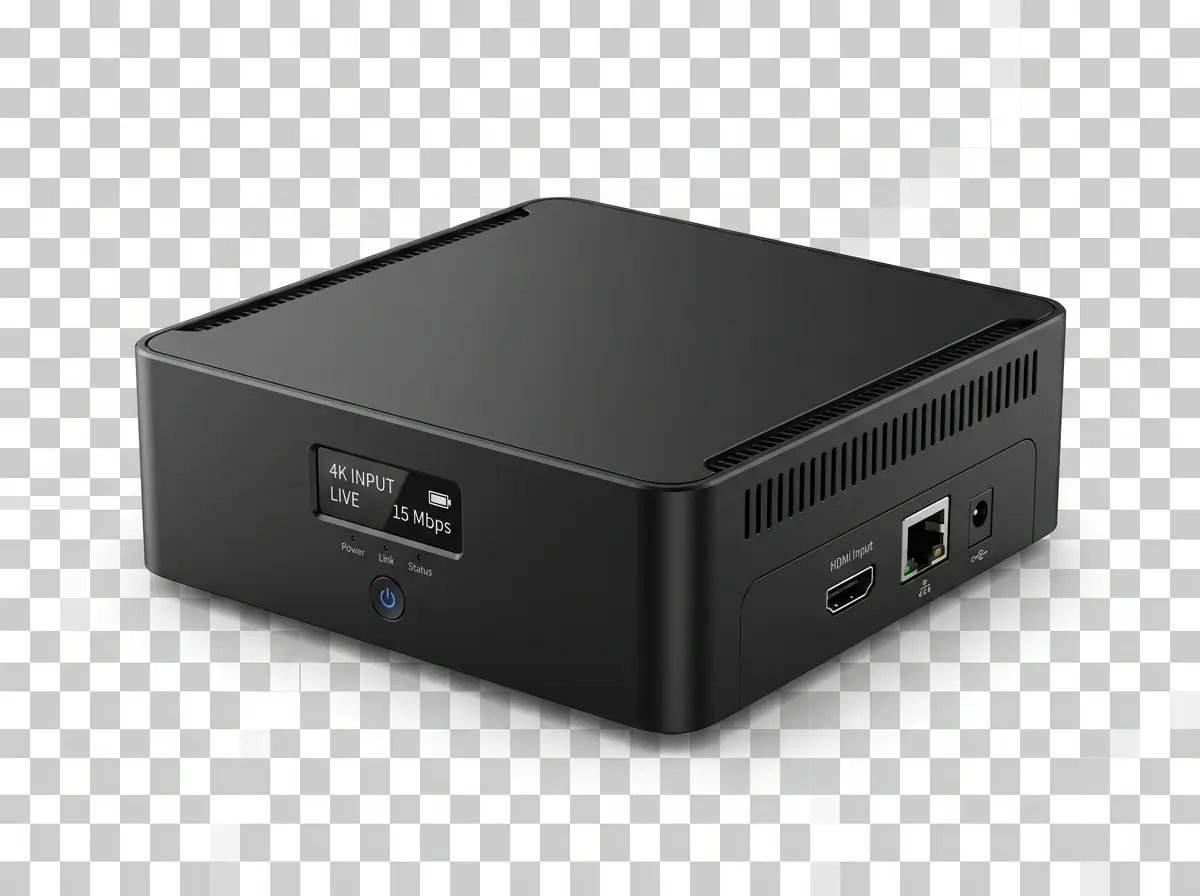
The device accepts a 4K UHD video signal via HDMI 2.0 or higher — the minimum standard capable of carrying 3840×2160 content at 30 or 60 frames per second. Some professional 4k iptv-encoder models also accept 12G-SDI, the broadcast-standard interface designed to carry 4K signals over a single coaxial cable for longer-distance professional installations.
That incoming signal — which at 4K60 represents approximately 12 gigabits per second of uncompressed data — is then compressed in real time by dedicated hardware encoding silicon. Purpose-built media processors handle the computational demand of 4K compression without the heat, instability, or latency issues associated with software-based encoding on general-purpose hardware.
The compressed stream is then packaged into a network transport protocol — RTMP, HLS, UDP multicast, or RTSP — and delivered to a media server, CDN, or local IPTV distribution network. End-user 4K displays with compatible IPTV player applications receive and decode the stream, rendering the full ultra-HD image on screen.
The entire chain — from camera or source output to viewer display — is what a 4k iptv encoder makes possible at this resolution level.
Why H.265 Is Essential for Every 4K IPTV Encoder
Codec selection is more consequential at 4K than at any other resolution, and understanding why H.265 dominates this category is important before evaluating any 4k iptv encoder.
At 4K resolution, H.264 (AVC) encoding requires bitrates of 40–80 Mbps to maintain acceptable visual quality. This level of bandwidth places enormous strain on network infrastructure — particularly for multi-channel deployments or systems distributing to large numbers of simultaneous viewers.
H.265 (HEVC) achieves equivalent visual quality at approximately 15–25 Mbps for 4K content — roughly half the bitrate required by H.264 at the same quality level. For any 4k iptv-encoder deployment, this efficiency advantage is not optional. It is what makes 4K distribution practical over standard enterprise network infrastructure.
Every serious 4k iptv encoder in 2026 supports H.265 as its primary output codec. H.264 support is typically included for backward compatibility with older playback devices, but H.265 should be the default choice for any new 4K distribution system.
Some premium 4k iptv encoder hardware also supports AV1 — the next-generation open codec offering further compression gains over H.265. AV1 playback device support is still maturing in 2026, making it a secondary consideration for most deployments, but worth noting for future-proofing discussions.
Key Specifications When Choosing a 4K IPTV Encoder
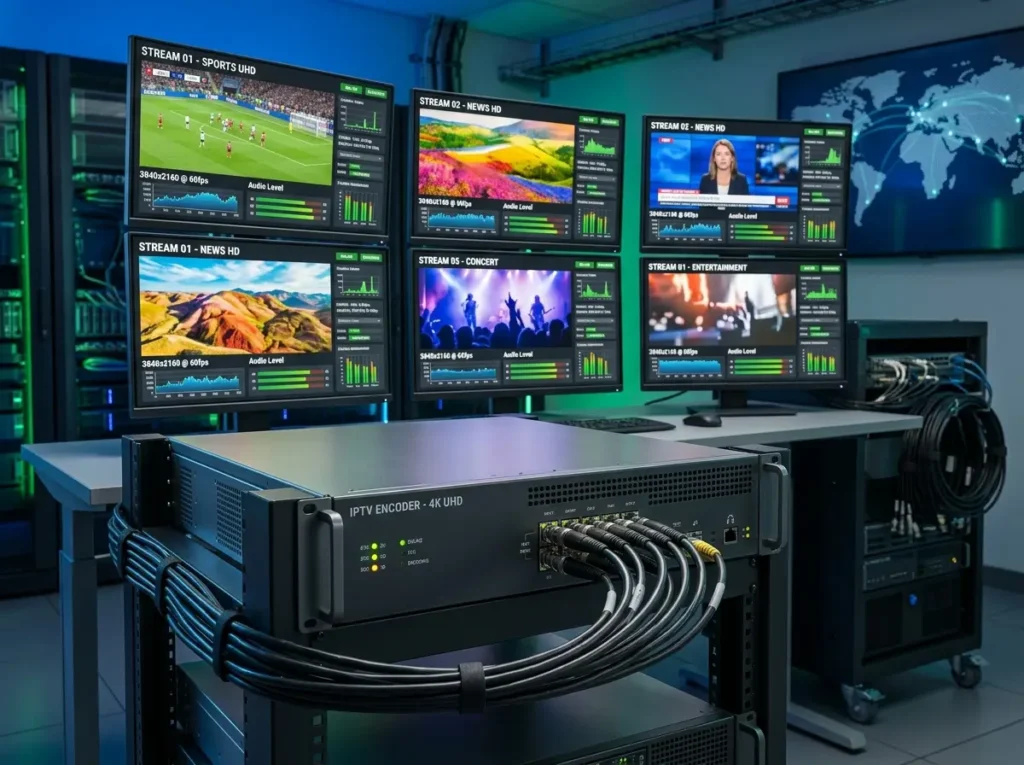
These specifications have the most direct impact on real-world performance when selecting a 4k iptv encoder for your deployment.
4K input interface. HDMI 2.0 or 2.1 is the standard for consumer and prosumer 4K sources. 12G-SDI is the professional broadcast interface for long cable runs and studio environments. Confirm the 4k iptv encoder you select accepts the interface your source equipment outputs.
Maximum frame rate at 4K. 4K30 (30 frames per second) is the baseline for most IPTV distribution scenarios. 4K60 delivers significantly smoother motion — particularly important for live sports and high-action content — and requires a more capable 4k iptv-encoder with higher processing headroom. Match frame rate capability to your content requirements.
H.265 encoding quality. Not all H.265 implementations perform equally. Quality at a given bitrate varies between encoding chips and their firmware implementations. Look for 4k iptv-encoder models that specify the quality of their H.265 output — ideally with published bitrate-versus-quality test results or independent reviews.
Output bitrate range. A quality 4k iptv encoder should support H.265 output from approximately 4 Mbps (for lower-quality distribution scenarios) up to 50 Mbps or higher for maximum fidelity applications. The ability to configure bitrate precisely allows you to optimize the quality-bandwidth trade-off for your specific network.
Low-latency mode. For live 4K applications — sports events, live performances, real-time monitoring — a 4k iptv-encoder with a dedicated low-latency encoding mode is essential. Glass-to-glass latency under one second is achievable with quality hardware and the right protocol configuration.
HDR support. High Dynamic Range (HDR) significantly enhances the visual impact of 4K content. Premium 4k iptv-encoder hardware supports HDR10 passthrough or encoding, preserving the expanded color and brightness range that modern 4K displays are capable of rendering.
Simultaneous output protocols. The ability to push to multiple destinations simultaneously — RTMP to a media server and UDP multicast to a local network at the same time — adds significant operational flexibility. Confirm simultaneous output capability in your chosen 4k iptv-encoder before purchasing.
Build quality and thermal management. 4K encoding places greater thermal demands on hardware than HD encoding. A 4k iptv-encoder intended for continuous 24/7 operation requires robust thermal design — either effective passive cooling or a reliable active cooling system — to maintain performance and longevity over multi-year deployments.
Network Requirements for 4K IPTV Encoder Deployments
A 4k iptv encoder introduces network infrastructure requirements that differ meaningfully from HD deployments and must be addressed at the system design stage.
Bandwidth per stream. H.265-encoded 4K streams from a 4k iptv-encoder typically require 15–25 Mbps per channel for broadcast-quality output. For internet delivery, upstream bandwidth at the encoder’s network connection must comfortably exceed this figure. For local network distribution, switch and router capacity must support the aggregate bandwidth of all simultaneous 4K streams.
Multicast infrastructure. For large-scale local network distribution — delivering the same 4K stream to many viewers simultaneously — UDP multicast significantly reduces total network load compared to individual unicast streams. This requires network switches that support IGMP snooping to manage multicast traffic efficiently. Confirm your switching infrastructure is multicast-capable before deploying a 4k iptv-encoder at scale.
End-device capability. 4K streams encoded by a 4k iptv-encoder require playback devices with H.265 hardware decoding capability. Older smart TVs, media players, or set-top boxes with H.264-only decoders cannot render H.265 4K content without frame drops or playback failure. Audit your end-device estate before committing to a 4K distribution rollout.
CDN and cloud delivery. For internet-based 4K distribution to geographically distributed audiences, a CDN with 4K delivery capability is essential. Confirm that your chosen CDN or media server platform supports H.265 4K streams at the bitrates your 4k iptv encoder produces.
4K IPTV Encoder Use Cases in 2026
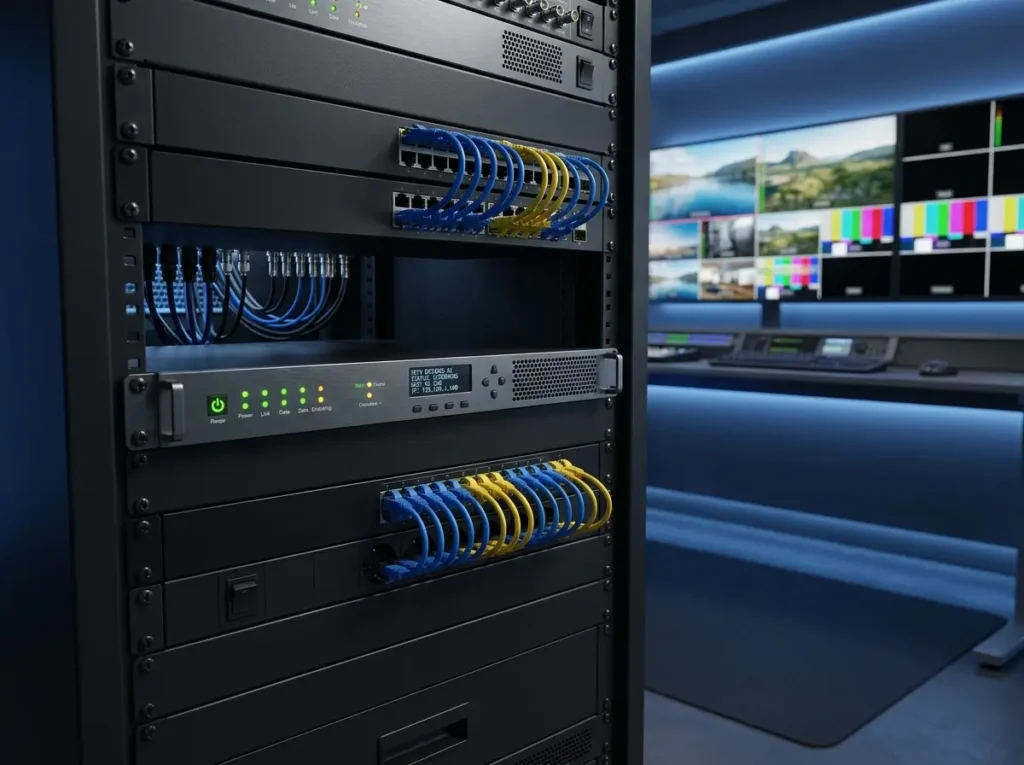
The deployment scenarios that benefit most from 4k iptv encoder hardware share a common requirement: premium visual quality delivered reliably at scale.
Premium hotel and hospitality IPTV is one of the most active deployment categories for 4k iptv encoder hardware. Properties investing in 4K guest room televisions require a headend capable of delivering ultra-HD streams to every room — making the upgrade from HD encoding hardware a natural next step.
Live sports and event production uses 4k iptv encoder hardware to distribute premium 4K feeds to large venue displays, broadcast partners, and premium streaming audiences who expect the highest available visual quality.
Corporate executive communications and boardroom video distribution increasingly deploy 4K encoding hardware to deliver high-fidelity presentations and video conferences to large displays across multi-site organizations.
Educational institution lecture capture at the premium tier uses 4k iptv encoder hardware to archive and distribute lecture content at resolutions that preserve whiteboard detail, presenter expression, and supporting visual materials with greater clarity than HD allows.
4K IPTV Encoder — Frequently Asked Questions
What bitrate does a 4k iptv encoder need for good quality output?
For H.265-encoded 4K content, 15–25 Mbps delivers broadcast-quality visual output suitable for large-screen viewing. Lower bitrates of 8–12 Mbps are acceptable for less demanding scenarios. H.264-encoded 4K requires 40–80 Mbps for equivalent quality.
Can a 4k iptv encoder output to multiple resolutions simultaneously?
Many models support adaptive bitrate output — producing simultaneous streams at 4K, 1080p, and 720p from a single input. This is particularly valuable for mixed end-device environments where not all viewers have 4K-capable playback hardware.
Does a 4k iptv encoder work with existing HD IPTV infrastructure?
Generally yes, provided the downstream media server and distribution network support H.265 and have sufficient bandwidth for 4K streams. End-device compatibility — specifically H.265 hardware decoding — is the most common limiting factor when integrating a 4k iptv encoder into an existing HD system.
What is the difference between a 4k iptv encoder and a 4K transcoder?
A 4k iptv encoder converts a raw uncompressed 4K input signal into a compressed stream. A 4K transcoder takes an already-compressed stream and re-encodes it — typically to change codec, bitrate, or resolution. Many modern 4k iptv encoder models include transcoding functionality as an additional feature.
How much power does a 4k iptv encoder consume?
Power consumption varies by model and channel count. Single-channel 4k iptv encoder devices typically consume 10–25W. Multi-channel rack units scale proportionally. Passive-cooled models generally consume less power than active-cooled alternatives and generate less heat in the installation environment.
Is HDR support standard in all 4k iptv encoder hardware?
HDR support is standard in premium 4k iptv encoder models but not universal across the market. If HDR preservation is important for your deployment, explicitly verify HDR10 or HLG support in the encoder’s specifications before purchasing.
Conclusion: Investing in the Right 4K IPTV Encoder
A 4k iptv encoder is a significant infrastructure investment, and the right choice depends on your input sources, network infrastructure, scale requirements, and quality expectations. Single-channel HDMI 2.0 models serve smaller deployments efficiently. Multi-channel rack units with 12G-SDI inputs suit broadcast and large hospitality environments. H.265 support is non-negotiable at this resolution. HDR capability is increasingly worth prioritizing.
Audit your network infrastructure before deployment — particularly switch capacity, multicast support, and end-device H.265 decoding capability. These downstream factors determine whether your 4k iptv encoder investment delivers the ultra-HD quality it’s capable of, or is bottlenecked by infrastructure that hasn’t kept pace.
In 2026, 4K distribution is no longer an aspirational tier — it is the premium standard that leading deployments are built around. With the right 4k iptv encoder selected and properly integrated, your distribution system is positioned to deliver the highest available visual quality reliably and at scale.